

Access To Funds For Early Retirement
For firefighters and other public safety employees, retirement planning doesn’t follow the same rules as everyone else. Between physically demanding careers, pension systems, 457s, and Deferred Retirement Option Plans (DROP), many firefighters find themselves eligible to retire much earlier than traditional workers.
Many of us know our 457s are accessible when we separate from service (regardless of age) and IRAs have different rules that lift at age 59.5, but I’ve found most firefighters have never heard of the Age 50/25-Year Exception.
This is one of the most important—but least understood—tax provisions that can impact early retirement income. Thanks to the SECURE 2.0 Act, this rule became more powerful for qualified public safety employees in 2023.
This article will break down what it is, how it works, why it matters, and a couple other strategies to access funds if you retire in your 40’s or 50’s.
What Is the 72(t) 10% Early Withdrawal Penalty?
Normally, withdrawals from qualified retirement accounts like a 401K or “Rollover” funds (like DROP money) in a 457 are hit with a 10% early withdrawal penalty before age 59.5 (the IRS technically calls it an “additional tax”).
This is in addition to ordinary income taxes. Read more HERE about how the DROP is taxed.
This penalty is governed under Internal Revenue Code Section 72(t), which is designed to discourage early access to retirement funds. However, there are several exceptions to this penalty—and one of the most important for firefighters is the Age 50/25-Year Exception for public safety.
The Age 50/25-Year Exception (SECURE 2.0 Expansion)
Historically, public safety employees had an early access provision tied to separation from service and Age 50. But SECURE 2.0 expanded and clarified this rule, making it significantly more useful for firefighters by adding the 25-Year Exception.
Under the Age 50/25-Year Exception, a qualified public safety employee can take penalty-free distributions from a retirement plan if:
The employee separates from service, and
The distribution occurs in or after the year the employee turns age 50, OR
The employee has completed at least 25 years of service, whichever comes first.
This means firefighters don’t have to wait until 59½ to access these funds without penalty if they meet the age or service-based threshold.
Please note, this does not apply to a spouse’s 401K.
How the DROP Fits Into the Equation
Many firefighters participate in a Deferred Retirement Option Plan (DROP), which creates a unique financial situation.
A DROP typically works like this:
You “retire” for pension calculation purposes
Your monthly pension benefit is frozen and credited into a DROP account
You continue working and receiving a salary
At separation, you receive a lump-sum DROP distribution that can be rolled to your 457 or an IRA
The DROP allows firefighters to continue working while their retirement benefit accumulates in a tax-deferred account. When a firefighter exits DROP and separates from service, they often have a retirement nest egg split across the following:
457
DROP lump sum
Roth or traditional IRAs
The 457 is accessible at separation, but without proper planning, accessing everything else could trigger penalties along with taxes.
However, under the Age 50/25-year exception, firefighters can access DROP funds within their 457 without the 10% penalty, which creates a powerful bridge between early retirement and traditional retirement account access.
When you request a distribution, you must notify your plan administrator that you qualify for the public safety early distribution exception and should verify the 1099 you receive at tax time is coded properly.
Example: Stephen is a firefighter who started his career at age 21. Now he's 47, wants to retire, and it makes the most sense for him to access some of his DROP benefit. Prior to SECURE 2.0, Stephen would have had to wait to separate from service in the year he turned 50 or later to access his funds without penalty. However, with the expansion of the Age 50/25-Year Exception, Stephen can leave the fire department at 47 and access his DROP because he has over 25 years of service.
Please note, rules for how long you can DROP and when you can sign up vary across the country.
Other Accounts That Can Be Accessed For Early Retirement
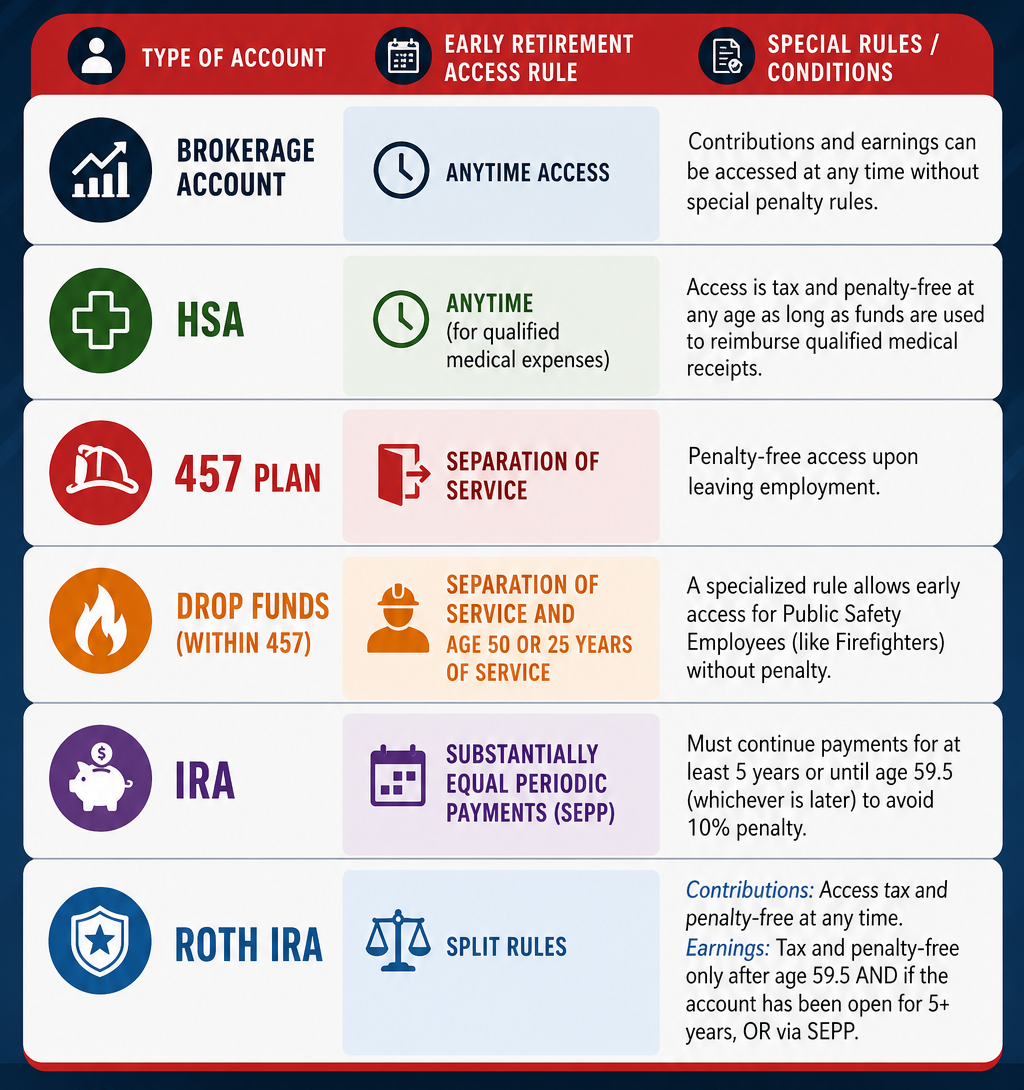
A taxable brokerage account can be accessed at any time without age restrictions—there’s no penalty, though you may owe capital gains taxes on investment growth.
A Health Savings Account (HSA) also offers unique flexibility: if you’ve saved your receipts, you can reimburse yourself for qualified medical expenses at any point in the future—even years later—effectively turning it into a tax-free reimbursement tool.
Roth IRA contributions (not earnings) can be withdrawn anytime, tax- and penalty-free, since you’ve already paid taxes on that money.
Even with the Age 50/25-Year exception, IRC Section 72(t) substantially equal periodic payments (SEPP) can remain useful in certain cases.
A 72(t) SEPP plan allows penalty-free withdrawals from IRAs if taken in a structured, IRS-approved payment schedule.
This is especially helpful when:
A firefighter retires before age 50 without 25 years of service and needs access to pre-tax IRA funds
A specific amount of income is needed before pension + Social Security begin
Roth IRA earnings need to be accessed
The rules for SEPP are complex and beyond the scope of this article – it's just important to know they exist!
The chart below outlines 6 options for accessing funds if you aspire to retire in your 40's or 50's.
Why All This Matters for Firefighter Retirement Planning
For firefighters, retirement is not just about when you can leave the job—it’s about how you structure income afterward.
The combination of pension benefits, DROP funds, 457/401K balances, Age 50/25-Year exception rules, 72(t) SEPP strategies, and other investments accounts like brokerage accounts and HSAs create multiple levers for designing early retirement income without unnecessary tax penalties.
The Age 50/25-Year exception under 72(t) is a valuable and underutilized planning tool available to firefighters, but the rules are strict, timing matters, and mistakes can trigger penalties. For many public safety professionals, the difference between a well-structured retirement and an inefficient one often comes down to working with a professional who understands how these provisions interact.